Cost Guide
How much does stock fencing cost per metre?
Why there's no one price per metre — and what actually sets yours.
Ask what stock fencing costs per metre and you'll get a different answer every time — because the price per metre depends on the spec, the ground and the run itself. A straight, open run on good ground is a very different job from a sloping boundary with gates and corners. This guide explains what sets the price, so you can compare quotes properly.
GSM Contracting installs agricultural, stock, domestic and security fencing, with our own plant and operators. We're based near Diss in Norfolk and work locally and further afield. We advise on the right materials for the ground and for what the fence has to hold, and install it to last.
What affects the price per metre?
The spec — posts, wire and netting.
The grade of netting, the size and spacing of posts, and whether you want a line wire or barbed top all change the per-metre price. A light sheep netting and a heavy high-tensile stock fence are not the same fence.
The ground.
Soft, wet or stony ground takes longer to drive posts into than clean, workable ground. Rock and tree roots slow it down.
The length of the run.
Longer runs usually cost less per metre, because set-up and moving between sections is spread over more fence. A short run carries more of that fixed time per metre.
Gates, corners and ends.
Straining posts at every end and corner, and hanging gates, take more time and materials than the straight runs between them. A run with lots of corners and gateways costs more per metre than a plain boundary.
Access along the line.
If plant and materials can follow the line easily, the job runs quickly. Fencing across awkward or boggy ground takes longer.
Clearing the line.
An overgrown or old fence line that has to be cleared or stripped out first adds to the job.
Choosing the right fence for the ground
The right spec depends on what the fence has to hold and the ground it's going into. Sheep, cattle and horses all ask different things of a fence, and a boundary that has to be stock-proof for years is built differently from a temporary division. We'll advise on the netting, posts and tops that suit your land and your stock, so you're not paying for more fence than you need — or putting in less than the job calls for.
How far apart should stock fence posts be?
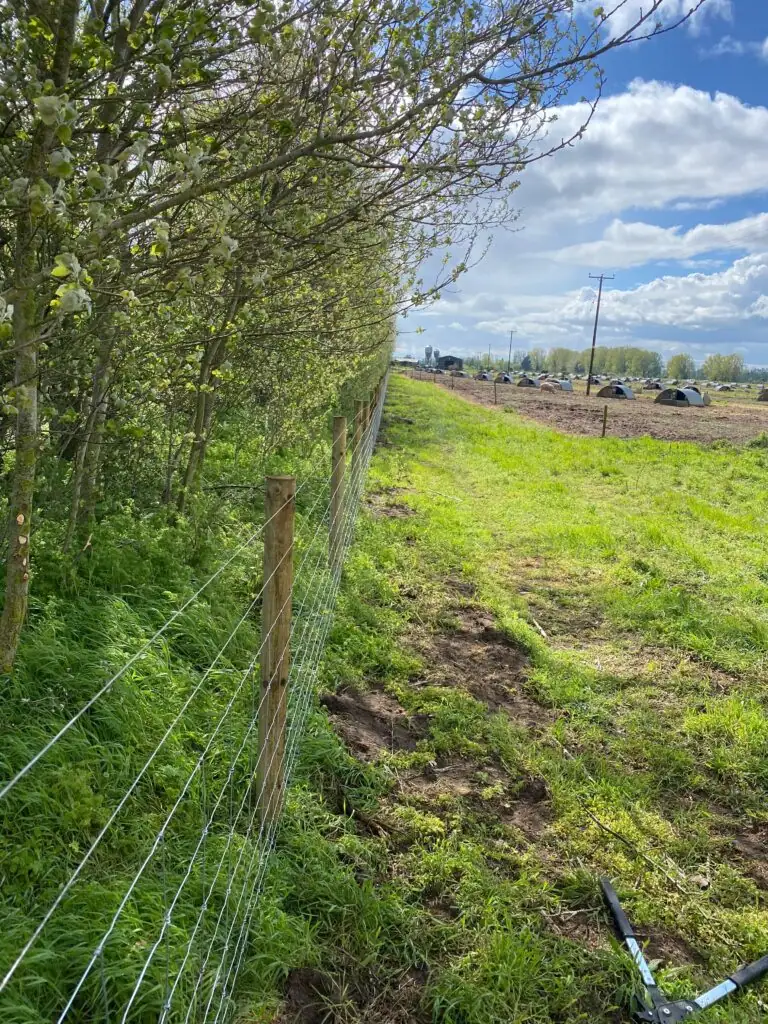
As a rule of thumb, stock fence posts sit around every 2.75 to 3 metres on a straight run, with straining posts at the ends, corners and any change of direction, and the netting strained tight between them. The right spacing depends on the ground and what the fence has to hold — closer on uneven ground or for heavier stock. It's part of what we set out when we quote the run.
Supply-only or supply-and-fit?
A roll of netting has a price; a finished fence doesn't come at the same per-metre rate, because the price of a fitted fence includes the posts, the straining, the gates and the labour to put it in straight and tight. When you compare quotes, check whether a per-metre figure is materials only or supply-and-fit — otherwise you're not comparing like with like.
How to get an accurate price
Tell us the length of the run, the ground, and what the fence needs to do, with a few photos and rough measurements by WhatsApp. You'll get a price with the materials and installation set out properly, and dates. For the full service, see our fencing service.
Common questions
How much does stock fencing cost per metre?
It depends on the spec — posts, wire and netting — the ground, the length of the run, and how many gates, corners and ends it has. Send the length and a few photos and we'll price it properly.
What do fencing contractors charge per metre?
There's no one rate: a short run with gates and corners on hard ground costs more per metre than a long, straight run on good ground. A fitted price also includes posts, straining and labour, not just the netting.
How much would a 30-metre fence cost?
A short run like that carries more set-up time per metre than a long one, and the ends, any gate and the ground all count. Tell us what it needs to do and we'll give you a straight price.
How far apart should stock fence posts be?
Around every 2.75–3 metres on a straight run, with straining posts at the ends and corners and the netting strained tight between — closer on uneven ground or for heavier stock.